Grave of The Fireflies
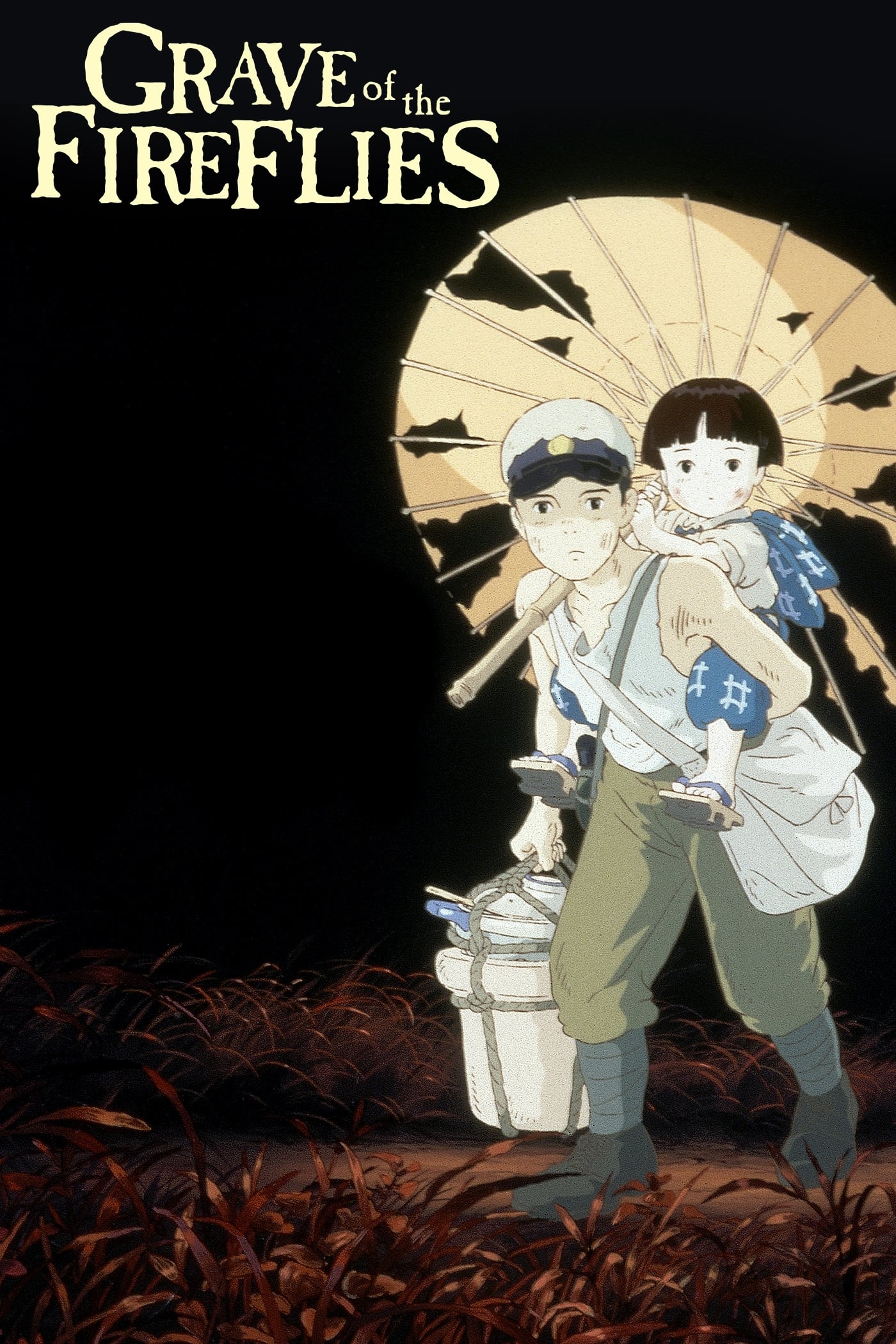
"September 21, 1945... That was the night I died."- Seita

"Why must fireflies die so young?"-Setsuko

"She never woke up again."- Seita

Grave of the Fireflies is a beautifully animated film that features heartbreak, happiness, and the cruelty of war. Unlike much of the first semester and previous short stories, Grave of the Fireflies focuses on the civilian life during war time, and how the affects of war change the lifestyle, mentality, and morality of "regular" citizens.
1) First off, this movie is heartbreaking in many ways. Just as we have often talked about the atrocities of war from a soldier's perspective, what do you think the atrocities of war are from a refugee and civilian perspective? Although the two, soldier and civilian, are very different things, they do share some similarities in the context of war. What are these similarities? What are some differences?
2) Throughout the movie, one could argue that there is symbolism littered throughout the whole movie. However, the biggest one must be fireflies, hence the title of the movie. What do you think the significance of the fireflies are to the movie? Are there just there for the aesthetics or are they featured for a deeper meaning? What did the quote "Why must fireflies die so young?" mean in the context of war?
3) What struck me greatly during the movie was the when the Aunt kept reprimanding Setsuko and Seita. She says, "Why should the lunch for those that work for the country and those that just sit around all day be the same? Seita-san. You're old enough; start thinking about how you can of help. You two don't give us any rice but expect to eat it. It just doesn't go that way." Do you agree with her? On one hand, she shelters both of them, giving them a place to sleep, and gives feeds them. It is a time of war, and complaining about meals may come off as being selfish and childlike. On the other hand, Seita stays to protect his sister and he cannot get a job or go to school. Who do you think is in the wrong? If so, who, and why?
Overall, I really love Grave of the Fireflies. It is an amazingly emotional film that showcases the often forgotten part of war, the citizens and innocents people caught up in the warfare.
Grave of the Fireflies (Hotaru no Haka)
Director...Isao Takahata
Screenplay...Takahata, based on the short story by Akijuki Nosaku
Music...Michio Marniya
Cinematography...Nobuo Koyama
Seita...Tsutomu Tatsumi
Setsuko...Ayano Shiraishi
Seita and Setsuko's Mother...Yoshiko Shinohara
Seita and Setsuko's Aunt...Akemi Yamagushi
Released 16 April 1988
Box Office...$516,692 (US)

1. In this particular story, I would say the line between soldier and civilian is especially blurred. This time, what's so similar is that the violence and death isn't in some far off place where war is being fought among soldiers, the violence and death is brought to civilian towns and doorsteps. With these particular air raids, it's not just the soldiers that are dying in combat anymore, but the civilians are dying in a war that they did not sign up to fight in. I would say the atrocities of this war are a lot more personal because, although still atrocious, it's not army sites that are being but destroyed, but it's family homes and schools. The atrocity for these civilians is losing loved ones that they didn't know they needed to be worried about because these loved ones were right at home with them. The atrocity for these civilians is coming back to the place where your house used to stand and finding everything in ruins and not having a place to go. The similarities are that the civilians become soldiers in that they are surrounded by war and death and fear.
ReplyDelete2. Throughout the film and in relation to the fireflies, sometimes it was hard for me to tell the difference between the firebombs and the fireflies. When the color and shape was blurred, i couldn't tell the difference could between them so I think one thing that the fireflies symbolize are the air raids and fire bombs that fell from the sky. Also, I think one monumental part of the movie that has to do with the fireflies is when Setsuko is burying them and reveals that she knows that their mother is dead. Although I am not completely sure what this symbolizes, I think this part shows a little growth and maturity in Setsuko and when Setsuko says, "Why must fireflies die so young?", it might represent the age of the majority of soldiers fighting in war. The soldiers are so young and although not all of them physically die in war, in the ones that don't literally die I feel like their spirit and their ability to be a young man and enjoy adolescence dies young in war.
3. I think the aunt was my least favorite character in the whole film. Although one could argue that it seemed reasonable for her to urge Seita to join the effort because he was capable and of age, she was extremely insensitive to Setsuko and Seita's situation. Their mother just died, their house has burned down and been destroyed along with all of their belongings, their town was destroyed, and it is not like Seita was just sitting around doing nothing, he was caring for Setsuko. She is so unfair to them and arguably the reason why Setsuko dies. She neglects them; she lets them leave. While yes, they could have stayed with her, she was horrible to them and they were miserable. She was in the wrong. While Seita's intentions were purely good; he dealt with the pain of losing his mother without showing it to Setsuko and became Setsuko's only guardian and parent, the aunt was selfish and cruel. She punished Seita and Setsuko for managing themselves and for just being kids who just got everything taken from them. Seita was the strongest and most responsible character in the film.
First off. This is the second time I’ve seen this film and it broke my heart even more than it did the first time (because of an age/maturity gap and) because it just always gets worse. From the perspective of the film, the atrocities of civilian life appear to be worse than that of a soldier’s life (however we also did not get much of the soldier’s perspective.) Seita did not even know they had lost the war. Maybe, it is worse to continue fighting when there is no hope than to know to stop fighting because you have lost. Civilian lives not only fell apart but were reconstructed in some of the worst ways imaginable. Soldiers and civilians are quite similar because all soldiers once were civilians. In that way, maybe soldiers are just civilians with perspective. A similarity: both civilians and soldiers die. Their father, the soldier, died and so do all our other characters that we come to love and empathize with. A difference is that the soldiers know they will most likely die while civilians still have hope. I think another difference is that soldiers know what to be afraid of, while civilians do not until it hits them.
ReplyDeleteWhen I first saw this film, I was confused by and did not understand the seemingly unspoken significance of the fireflies. However, on a second viewing, it makes much more sense, which is perhaps what made the film so much more heart wrenching than before. When Setsuko asks, "Why must fireflies die so young?,” we see two fireflies travelling through the shelter to the box of their mother’s ashes. I think these two fireflies are Setsuko and Seita who eventually join their mother. The fireflies die when inside the mosquito net just for one night, signifying that no person can live and succeed under such circumstances; it is impossible to live trapped like that. The children, the civilians in general, die so young. Setsuko accidentally crushes a firefly when she tries to catch it, and it lays broken in her hand. This scene has stayed with me because even when trying to be as gentle as possible, the firefly was still crushed. Something beautiful can be crushed so easily, which I think symbolizes humanity in the context of war.
I don’t think we can label someone as being in the wrong in this situation because in war, social customs and structures break down to the point where there is almost no “in the wrong.” Everyone is just trying to survive. Because I am biased due to the context of the film, I hate the Aunt, but looking at it objectively, I do not believe anyone to be in the wrong. I would rather work than watch everyone I love die, so I think the Aunt needs to suck it the fuck up.
1. Although last semester we read several stories about the civilians left home during war (all the stories from You Know When the Men Are Gone), we have never witnessed those whose lives change during war due to the fact that the fighting takes place on their home soil. This film brought a new perspective of civilian/refugee life, and one that I think is extremely important to keep in mind while discussing the atrocities of war in its entirety. While Seita and Setsuko and the rest of the civilians surrounding the children were not actively engaged in combat, I would say that war impacted their lives on a scale similar to that of the soldiers, and in some ways the impacts were even more atrocious. I think that the atrocities of war are perhaps even more magnified in civilian life because to them war means the absolute disruption and destruction of everything they previously knew and understand. Even in war, militaries provide its soldiers with some semblance of order and structure, whereas the terror-bombed citizens of Japan were left with nothing; no food, no safety, no sign of civilization. In this way the line between soldier and civilian becomes especially blurred and indistinguishable.
ReplyDelete2. While not only extremely beautiful, I think that the fireflies added a rather mystical element to the film that perfectly captured the joys of youth by contrasting them with the sobering and maturing effects of war. As Molly mentioned in her blog, the distant firebombs look remarkably similar to the fireflies, and I think that this reveals a deeper message about the ability and terrible power war has in shaping lives, especially the lives of those so young. I think that the quote and the title are significant in that both speak to how fireflies, in this case synonymous with carefree youth and innocence, become erased so quickly when faced by the atrocities of war and are instead replaced with hopelessness and despair.
3. One could argue that Seita and Setsuko’s aunt was struggling during the rationings and difficulties of the war, and that Seita’s unwillingness to work placed an undue burden on her. However I simply do not see it that way. For one thing, their aunt did not appear to be struggling either economically or physically, and she showed a complete disregard for the children’s tragic situation that I found rather disheartening. Even if Seita did try to find work, it is unlikely that he would have been able to find a job in which he could also bring along his young sister, and Seita’s dedication to Setsuko was consistent and apparent throughout the film. Furthermore, the aunt seemed to be urging Seita to find a job assisting the troops, and given his circumstances and the fact that his mother died as a result of the war, I can understand why Seita would want to distance himself and his sister from the war as much as possible.
I think the atrocities of war from the perspectives of the civilians are attacks on the civilians themselves—total war is an atrocity from the civilian perspective. While soldiers and civilians are not both inherently tied to the experience of war—look at our lives that are unaffected by our current wars—in cases of total war, the soldier and the civilian are not so different. For example, they both radically change their lives to progress the war effort (like the father and daughter that worked for the Japanese empire’s war effort). The effect that civilians have on the war, and the effect the war has on the civilians are radically different. Seita did not have the machine guns that his father’s armada did, and the terror of death was a periodic occurrence for Seita and Setsuko; it must have been daily for his father or the kamikaze fighters in the war.
ReplyDeleteI think the moment in which Setsuko crushes the firefly by accident is very telling of the fireflies’ symbolism. The fireflies represent the purity and fragility of children. They show how innocent the children are in times of war, but Setsuko was too fragile to survive, even after the end of the war, just like the fireflies were too delicate to survive one night in the shelter. I would argue that the quote is a commentary on the atrocious nature of total war; “why must fireflies die so young?” in war could easily be changed to “why must children die so young?”
I think that the Aunt is in the wrong. Her anger at the children is understandable, given the fact that she is living off rations in a hopeless-looking war, but she needs to be the mature one, not Seita. Seita saw his mangled mother die, has to provide for his younger sister, and has no contact with his father. I would argue that anything of a complete breakdown from Seita is surprising given his circumstances. The aunt’s anger is understandable, but does not come from a place of understanding.
Good blog entry, Sophia!
ReplyDelete1. As Keyes said above, of course, at the end of the day, atrocity—in this case, terrible death by either being burned by the incendiaries the American bombers drop as is the case with the children's mother or by gradual starvation in the case of Seita and Setsuko—is objectively no different than the death of the children's father whose ship is sunk, as is most of the Japanese fleet. We can only hope the father died quickly, as that perhaps is the
"best" way to die in war. But I somehow doubt he did. Unlike the children and the civilians of Kobe, and as we've said again and again in class, he "signed on" to the possibility of death. Death in war can be terrible, atrocious to use our word of the semester, be it the soldier in SPR with his intestines spilled on the beach (or a terrified Wade or Mellish) or watching an animated 5 year old starve to death. But logically, emotionally, morally, we say to ourselves 5 year olds should not starve to death in war. Mothers should not be die from fire bombing. When Caparzo says it's not right to shoot repeatedly a wounded man, and Miller says, basically, it is because the men plugged with bullets is a combatant, we have to, I think, agree with Miller. In the logic of war, you kill the enemy. But does that mean we also get to starve children and burn their mothers to death?
2. Like the previous answerers, I'm thinking on this. How war kills beauty? How the world kills beauty (they die when trapped in the mosquito netting)? I keep remembering the brief flashback when Setsuko is burying the fireflies and Takahata cuts to the burial of the civilians, including the children's mother. Is this value of life in war, be it insect or human?
3. We got to talk about this tomorrow. I know what Takahata (and Akijuki Nosaku, the story's author) think: but I will not reveal it. The Aunt is hard, unkind—no sentiment there when the children leave. Of course Seita can't make himself and his sister survive. What starts off as an adventure out of a children's book—is this how he envisioned it?—becomes a lesson in survival. A telling—and for me infuriating—moment is when we see the teenage girls return home as Setsuko is dying. The girls clearly come from a family with resources—their clothes look new and clean, they are healthy, their house is intact—and meanwhile our kids are living in a dugout and starving. Did they have to live in the cave? Could Seita have looked for work? Could he have been less proud? Did he and Setsuko have to starve? That's my question to go along with Sophia's.
1) The most atrocious part of this story, in my eyes, is the involuntary sacrifice that has been forced upon Seita and Setsuko. They are not soldiers, they did not sign up for any of the suffering they endure throughout the film. And yet it is arguable that they are just as much of a target— if not more so— as soldiers are. They face trauma and violence in ways no person should have to endure, much less children. I don’t think it is at all fair for their aunt to insinuate that they are not making sacrifices, aren’t suffering because of the war. These children have lost all of their family, their home, and later their lives without ever signing a document consenting to their risk.
ReplyDelete2) I think the fireflies are representative of two very important parts of the story: the children, and the bombs dropped onto their city. The bombs, children and fireflies share an alarming amount of similarities, the most primary being the amount of time they exist. Fireflies have short lives, a fact that Setsuka points out, dejectedly. They bring joy for a short time, and disappear. In a similar way, the bomb raids experienced in their city are not long, lasting only for a few minutes at a time. The bomb’s lives too are short-lived. The two children’s lives are cut heartbreakingly short because of the war. The siblings easily could have lived long and happy lives in any other environment, and yet they both die before ever getting to live their lives. These three symbols together represent things that are not around for long, but have an incredibly meaningful and significant impact when they are present.
3) I am not entirely sure how I feel about how the aunt reacts to Setsuko and Seita. I think I definitely expected her to be more affectionate and understanding, considering their mother— her sister— has died. One would assume that she would have more compassion for their situation, understanding just how overwhelmed they are and knowing that they’re doing the best they can. But at the same time, I definitely think its important to acknowledge the things she is going through as well. She’s having to take care of two extra people at a very stressful time with little food or resources. She is being extremely generous in letting them stay, even if she doesn’t do so in a loving or kind way. I do, however, think she should not have let the children go off on their own to live in the bomb shelter. I think she could have stepped in as an adult to ensure their safety. No matter how rude the children may have been, they deserved to be safe.
1)The gore and atrocities of war are not exclusively seen by soldiers. Seita and Setsuko see dead bodies, totally destroyed cities, etc. They see much of what soldiers do. However, I agree with Molly. It is much more personal for the civilians, despite never seeing their enemies in person. They never signed up for war, yet their homes and families are often totally demolished.
ReplyDelete2)While I liked the aesthetic purposes of the fireflies, I do believe they are symbolic as well. Fireflies are sources of light, and in a movie that has so many dark and haunting parts, light is rare. I think the fireflies symbolize hope and goodness, and in war, these things die. Eventually, the light goes away and the darkness consumes everyone. I think their appearance also foreshadows the siblings’ deaths. Even a character as pure and innocent as Setsuko dies because of the war, leaving the audience and her brother wondering why she must die so young.
3)I don’t think either character is totally in the wrong, but I side more with Seita. This is war, and like in “When Engaging Targets, Remember,” there often is not a right answer. I am still furious at the Aunt for lacking empathy and for not helping the kids more, but I partially understand her perspective. She feels like Seita should be doing more to fight the war and that he doesn’t deserve help, and personally, I find this selfish. Yet, they have different priorities, and who am I to judge them? I value both hard work and my family, so it’s hard to take a side on this one, especially had we gotten the story from the Aunt’s perspective. However, I was annoyed that the Aunt called the rice “hers,” when Seita and Setsuko’s mom’s clothes were used to buy the rice. This makes me lean in favor of Seita, but I do think he should have stayed at the Aunt’s where Setsuko might have stayed healthy.
ReplyDeleteI agree with Jordyn that soldiers and civilians are ultimately the same people just with different perspectives. They are faced with different challenges and therefore atrocities because they have slightly different goals and conditions. Although they are different in some ways, both soldiers and civilians find the will to survive by loving and protecting someone. In the Fallon stories, the men married before they went to war so they would have someone to fight for. Having a loved one to protect gives the soldiers and civilians purpose to persevere. In this movie, Seita and his sister are only able to survive because they have each other. The happiness they find with each other makes the war bearable. These moments of laughter exist even with soldiers through the tight knit communities they form. After his sister dies, Seita is completely alone and therefore loses his will to live. I would argue many soldiers whose spouses have left them, for example Sleed, feel similarly.
I agree with Keyes that the fireflies represent Setsuko’s innocence. I think they show the innocence of not only children, but all civilians caught up in the atrocity of war. Like the fireflies caught in the netting, none of the civilians deserve to die, but they were at the wrong place at the wrong time. In addition to representing innocence, the fireflies also represent persistence. Even though some die, the others continue on just like civilians in war.
I agree with everyone that the aunt has assumed the role as the antagonist in the film. Through movies and books we have read, it is clear that the only way to survive war is to band together and help one another. Instead, the aunt adopts an every person for themselves mentality. I found the aunt’s hostility toward Setsuko particularly unacceptable because it is the aunts responsibility to care for her.
Prompt ONe: One of the atrocities--a moment which made me rather sad--was the utter lack of food. What was there, often was sent to the military, and nourishment was so scarce that even a farmer was unable to spare his crops for Seita. I remarked, earlier in the film, how Seita and his sister were provided a ride and other benefits due to their status as children of a navy man. This inequality (the strong preference for military and those around it) was what made the children’s deaths even more tragic. The entire film, Seita had worn a navy cap, presumably just like his fathers, yet despite the systems in place, he could not benefit. And when he lived with fellow civilians, it was this pride of being the son of a soldier that drove him to the shelter, refusing their help, striking out on his own, and ultimately starving to death like his sister.
ReplyDeletePrompt Two: I remember how Seita’s sister said a plane passing overhead was like a firefly. And I know that japanese kamikaze pilots have often been referred to as fireflies. “The firefly is an image often used in Japan to symbolize the kamikaze and death because of its association with love, poetry and a very short life.” (seattle times) IN the context of this film, just how Seita’s sister asks why are the fireflies dying? (Showing her ignorance to the natural world), so too does Seita enter a bank, not knowing that the war has been lost. Here, the title “Grave of the Fireflies,” is fitting because the war has been lost and there has been a death of those who fought for their country. Ironically, despite his navy-themed hat, Seita was rather the opposite… SHirking his duties when staying with the aunt, and earlier moving past a well and bucket when small fires had formed behind him, in no way did he ever “do anything” for his country.
Prompt Three: They’re both doing wrong. Seita should have been more helpful, and the aunt shouldn’t have been so stingy (even pocketing their comforts for herself and not returning all the rice!). However, these acts of self-preservation cannot be criticized in this awful situation of famine, when it’s the government’s fault for staying in such a resource-consuming war (everything goes to the soldiers!). Honestly, had the aunt taken care of Seita and his sister for the entire film, her family may very well have starved too. In this situation, it’s hard to criticize someone who is just trying to stay alive, even if it results in another’s death. What’s worse: Everyone dies? Or just the two orphans who showed up and took your food? For the aunt, that’s an easy choice to make.
1. I think that the atrocities of war from a civilian perspective are worse, as, ulike soldiers, civilians are untrained and unprepared to deal with atrocity. Bombing and other atrocities like we see in the movie were designed to terrify and to decimate populations. They are meant to destroy moral on the “home front” and use the civilian’s terror to force a country into surrender. To do this, rather than only attempting to kill as efficiently as possible like in war, these attacks are engineered to damage and kill in a terrifying way, making them that much worse for the untrained, unprepared, victims.
ReplyDelete2. I agree with Molly that the fireflies often looked like the firebombs, which I found to be a fascinating decision. The fireflies at one point help to comfort Setsuko, providing a light in the darkness that scares her, yet they are animated to appear similar to the firebombs, a weapon designed to cause terror as it destroys civilian homes. I think that, while war can kill many types of beauty, there still is a beauty in war. There are the firebombs that, at a distance, look like millions of fireflies falling through the sky, there is that shot in SPR with the men crossing the French countryside in front of a beautiful full moon. While war destroys beauty, like all those beautifully crafted homes we see near the beginning of Grave of the Fireflies, it also creates it.
3. I have a few conflicting opinions on this. On one hand, I think that the aunt was initially showing great kindness accepting these children into her home, as it doesn’t seem like they know her that well, but on the other hand, they did just lose their home and, as she later finds out, their mother, so it feels more like a necessary kindness. I understand her standpoint of where they children need to help the country, especially since it is a time of war, and, as we see, food is heavily rationed, yet, that doesn’t change the fact that I wanted to, and still want to, yell at the screen saying: “THEIR MOTHER JUST DIED! GIVE THEM A BREAK!” I think, while Setsuko could have tried to find a job or just help out around the house more, the aunt is ultimately in the wrong as these children are in an awful situation and have basically lost their entire livelihoods.
*In the last prompt, I said Setsuko instead of Seita.
Delete1) I think that the atrocities in this story were clear through the eyes of the Seita and Setsuko, but are harder to see through the lense of a soldier. For an American or Japanese soldier, the entire country is at war. The aunt even states, “Why should the lunch for those that work for the country and those that just sit around all day be the same?” She shames Seita for not being involved in the war effort showcasing that it is a nationwide issue. That is why, from the perspective of a soldier, I don’t think that the bombing of the cities is an atrocity or it is just as much an atrocity as bombing a base. From the eyes of a civilian, this is clearly an atrocity because their involvement in the war is varied and very limited in the case of Seita and Setsuko. I think that countries would like civilians and soldiers to share the same love and fight for their country, but as seen through Seita and Setsuko, the average boy and girl are not involved in the countries affairs directly. Although these children have a father directly involved in the war and a mother victim to it, they do not engage in the effort because they have more important things to think about like hunger. This shows that while soldiers and civilians may be affected in very similar ways by the war, i.e. the bombs, they do not necessarily share the same mentality.
ReplyDelete2) I think that fireflies symbolize hope. Seita and Setsuko bring the fireflies into their living space to lift their spirits during the night. Setsuko smiles and laughs as she watches them light the dim area. This is a moment of genuine happiness that was rare that late in the movie. The two children were happy despite being starving. Then, in the morning, the fireflies are dead and Setsuko says "Why must fireflies die so young?" The quote symbolizes how quickly the world can become devastating again. The moment of airness is destroyed by the gravity of real life. One minute the characters are enjoying their day, the next they are being told to run to the shelter to take cover from bombs. When the fireflies die, the tone of the movie changes really quickly. Seita begins to lose Setsuko and they both slowly starve. The fireflies brought hope in a time of desperation, but after their death the movie becomes even more bleak.
3) I think that in many ways the aunt is correct. The circumstances in Japan are extremely tough especially when it comes to food. Seita should have gotten a job or helped the war effort because he was not making himself useful at home. I think that the Aunt could have watched over Setsuko during the day while Seita pitched in. As John said, a lot of the choices Seita made came down to pride, which in many ways caused the deaths of both him and his sister. If Setsuko had swallowed his pride and apologized to his aunt, both him and his sister would have been fed. Also, if Seita had admitted to himself he needed help in a similar manner later on in the story, he may have brought Setsuko to a doctor earlier. This would have caused him to take the money out of his mother’s account earlier, and may have saved his sister’s life. Overall, I think that the aunt did not approach these issues in a very understanding way considering the death of the children’s mother, but she was right.
If anything, I find atrocities involving civilians and refugees far more horrific than those involving soldiers. At the very least, when it’s between soldiers, you have the (sometimes flimsy) justification that what’s going on is a job hazard. Trying to kill the other side means that they will probably hate you and try to kill you back, sometimes in horrific and inventive ways. I don’t mean to diminish the atrocities experienced by soldiers, but there’s a power mismatch involved in situations like the firebombing of civilians because they aren’t trained or able to fire back. Nor are they, by definition, supposed to. Even in a society engaged in total warfare, it’s chilling and, to me, profoundly wrong. In terms of similarities, these civilians also experience the uncertainty that soldiers do, where any moment could lead to sudden, meaningless death, or the loss of loved ones. It takes only minutes of firebombing for Seita and Setsuko to lose their mother, despite her hiding in the shelter and to become homeless. However, there is less obvious violence in this situation. Seita is not expected, at 14, to be killing for his nation, for all that he wears a uniform. Besides the firebombing, the violence is more insidious: the slow creep of starvation versus guts falling out of a man’s body. That being said, such horrors are also readily available in the aftermath of the firebombing.
ReplyDeleteI think the fireflies are innocents and Setsuko’s question is reflective of the senseless cost of war on those on the sidelines. They live and they die with no one to mourn them, fragile and temporary, as well as practically invisible. The fact that there is a grave, a monument to these invisible costs is an exception, not the norm. However, they are also fireflies, not butterflies or cherry blossoms, or some equally available sign of impermanence. I think it’s also an intentional parallel with the imagery of firebombing, which emphasizes the connections to war. Also, some species of fireflies (and I suspect with how quickly they died, this variety is among them), don’t have mouths as adults. They live only long enough to try and reproduce and starve to death shortly afterwards.
I think it’s important to keep in mind that they are, in fact children, and young children who have just been through a terrible trauma at that. It might be childish to complain about food, but even if they are forced to make incredibly adult decisions at their age, it is entirely too much to expect them to be adults all the time. And the fact is, they are getting less to eat. I understand that it must be frustrating for this distant aunt of theirs to suddenly have to take in two children and feed them on wartime, especially when their stay goes longer than her generosity, but she is also the adult in the situation. I don’t know what options are available to Seita to help out, but it seems as if, for a while, he does try by bringing their stored food and giving up his mother’s clothes to be sold. Also, aren’t he and Setsuko supposed to be receiving rations? They get biscuits at the makeshift school hospital, but it isn’t clear later on who is collecting them. That being said, it would probably not be enough for them to survive on. To her credit, Aunt never does kick them out. Seita decides to leave. I do hold her accountable for letting these children go off with no destination in mind and probably knowing that they have nowhere else to go. However, I don’t think it’s necessary to blame one person in this scenario; for me, that comes too close to trying to assign meaning to their deaths. It seems clear that they are considered no one’s responsibility in these turbulent times and fell through the cracks. Any of those adults could have played a bigger role in saving them, but in a world at war, they were left behind. Separately, I also have trouble understanding why Seita didn’t go back when it was clear they were starving. Perhaps that was also childishness, but I don’t know that he would have been so proud as to jeopardize their survival. Or perhaps he simply didn’t understand the severity of the situation yet. While perhaps he is to blame for his bad decision-making, I find it difficult to hold a child accountable for his sister's death when he has tried pretty much everything he possibly can to save her.
Delete(last sentence got cut off) So perhaps this is cheating, but if we're looking at who was wrong and who was to blame, I blame the war and the world it creates.
Delete1. For refugees, they have to face the physical and psychological aftermath of war. They have to rebuild a life for themselves often from scratch. Soldiers must also deal with the psychological repercussions of war such as PTSD and many soldiers come home wounded and their homes and families are completely different from how they remember. Often, but not always, soldiers choose to enlist, but civilians and subsequent refugees did not choose to be a part of a war zone.
ReplyDelete2. The fireflies could represent hope because they are literally Seita and Setsuko’s light in the darkness when they first sleep in the bomb shelter. Children often are the most optimistic about life and have the most hope for the future. However, especially in wartime, one’s hope for a future dwindles with the passing days and the rising death tolls.
3. The aunt is most definitely in the wrong because her cruel treatment of Seita and Setsuko is what drove them away; however, a true tragedy of the film is that had Seita swallowed his pride, he and Setsuko would have lived. In regard to the aunt’s remarks about portioning food, I understand what she is getting at but she is just wrong. Everyone needs to eat and generally people of the same age and build eat the same amount of food somewhat regardless of their activities. Maybe if Setsuko and Seita had stayed with the Aunt they also would have become malnourished give her rationale, but I think that is unlikely.