“Nobody talked. Nobody had any good war stories to tell” (70).
"The major told Billy that the Green Berets were doing a great job, and that he should be proud of his son. 'I am. I certainly am,' said Billy Pilgrim" (77).
"Billy tried hard to care" (73).
 |
| "The Von" just doesn't have the same ring as "The Hem". |
First, an aside. As we mentioned in class that we already know how this story begins and ends and key bits of the plot as well. Here’s a well-known chalk talk that Kurt Vonnegut did about the shape of various stories. This is the transcript of the whole thing, and this is a 4 minute video excerpt of the talk. (He doesn’t get to his final point that I think satirizes the whole concept of story shapes, but hearing him illustrating his points with John-style sound effects is pretty excellent.) It’s a fun thing to watch/read if you have a moment. I especially like what he says at the end of the speech:
"The truth is, we know so little about life, we don’t really know what the good news is and what the bad news is. And if I die—God forbid—I would like to go to heaven to ask somebody in charge up there, 'Hey, what was the good news and what was the bad news?'"
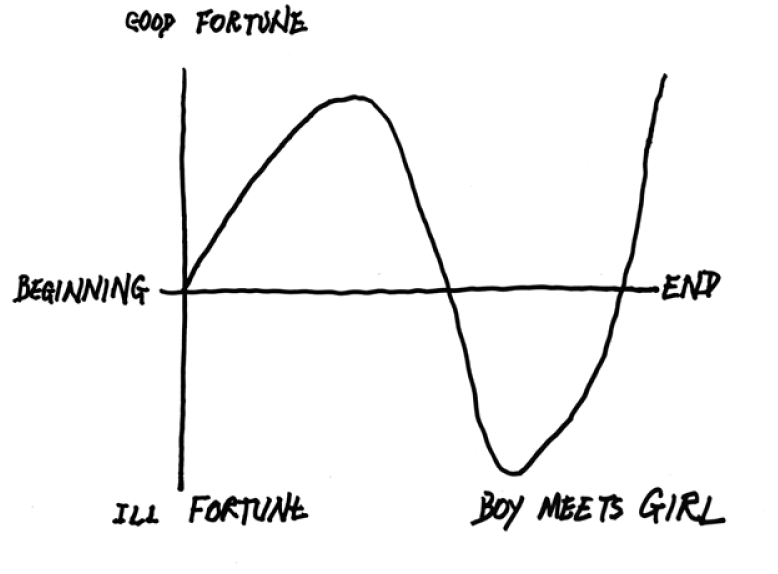
It makes me think about what we know as good news or bad news in this story, which most certainly does not have a traditional, linear plot structure. For one, we keep getting flashbacks in this third chapter. This time, they don't always end with people dying.
1) What do you think connects the flashbacks in this chapter? Is there a single, thematic connection and what does it contribute to our understanding of the story? If not, why do you think Vonnegut uses the flashbacks that he does? Why time travel in the first place?
Pick one of the following:
2a) We get to see the Germans for the first time in this chapter. To me, they appear to be a pretty ragtag bunch, with misfitting shoes, an Eve-like youth, and a farm dog named Princess who's been conscripted into the war effort. How does this portrayal of "the enemy" compare to those we've seen in other works (Grave of the Fireflies, Deer Hunter, Saving Private Ryan, etc.)? Is Vonnegut making a point with his portrayal?
2b) What do you think of Billy's passivity? Whether it's almost dying in the snowy, German countryside or not protesting Vietnam, or driving through the "black ghetto" without stopping, he avoids confrontation and really doesn't take action at any point at all. Why do you think this is? Is he a likable main character?
And finally:
3) Was there a particular quote or moment that stood out to you in the last two chapters? Why?

1). While there are many flashbacks in the story—the sleepy doctor, the driving scene, prayer scene, etc—I do not see any continuous thematic connection between them other than their randomness. The setting of the time travel seems relatively arbitrary. I think this is intentional. So far, these arbitrary flashbacks are a key element in Vonnegut’s “war story.” Vonnegut uses the recurring presence of these strange sidetracks in his war story to mimic how war too is confusing, bizarre, and totally arbitrary. I would argue that Vonnegut uses time travel because it simply makes the least sense to the reader. While this makes his story “untrue” in the classical sense, the time travel makes SHF a true war story in the O’Brien sense. Time travel gives the reader a sense of confusion—just like how the soldiers feel during war.
ReplyDelete2a) This portrayal of the enemy is wildly different from the past works; gone are the days of black situates mowing down the poor Americans on Normandy Beach. These aren’t the “bastards” that Kovic wants to murder. These are old men and beautiful boys. Vonnegut is defiantly making a point with this almost harmless portrayal of the Germans: THERE IS NO VILLAIN. He said he had never written a story with a villain in it, and SHF is no exception so far.
3) I loved the image of the Americans taking turns to stand and sleep. It just seemed like such a pure moment of comradery and solidarity in the face of trial. It made me feel so close to happy; I am surprised Vonnegut didn’t have the train crash to spoil it.
Good questions, Anna. I'm the first to answer. Maybe the teacher will notice and reward me. Probably.
ReplyDelete1. I was looking at the flashbacks and I was struck by how I don't really know what the present is in the novel—the Tralfamadorian way of looking at the world, everything happening simultaneously—gets played out perfectly in the way the flashbacks occur. When I was in NYC a few weeks ago I saw a jazz group and in one of their long songs I could not figure out where the "1" was: I feel the same way here. But anyhow, thinking about the first flashback, the optometer moment, and its focus on eyesight, it seems to me that the horrors Billy experienced in his life are what keep plaguing him. Will he see them clearly and act on them? His patient asks him if he saw "something terrible," and of course he did. Which for some reason reminded me of the Cyclops in Homer and how one eye just doesn't cut it for full vision—the same number of eyes the Tralfamadorians have. Billy has two: can he use them both and learn from what he sees?
2a. The Germans, to me, are just Americans in different uniforms. They can be cruel, they can be compassionate. The middle-aged corporal who leads the men capturing Billy and Weary is a mirror of Sgt. Horvath in SPR: a professional soldier, "tough as dried beef, sick of war." And looking to surrender. He's not going to fight to the death. Horvath does, yes, but if he is clearly sick of war too and, if the roles were reversed, I could see him looking to surrender too. The German guards fill the canteens for the American prisoners. Vonnegut made clear in Chapter One that there are no villains here. And these Germans are not the villains—they are soldiers who do what all soldiers do: they kill the enemy. Sure, they shoot the scouts in the back—as the scouts, waiting to ambush them, would have done.
3. "Billy was not moved to protest the bombing of North Vietnam, did not shudder about the hideous things he himself had seen bombing do. He was simply having lunch with the Lions Club..." Anna mentioned Billy's passivity. It is passivity, yes. Or is it his need to forget about the hideous things he saw? I'm thinking of Manny in "Inside The Break"--actually many of the characters we've encountered--and how it's clear they would like nothing more to forget what happened. Ron Kovic, we now know, is the exception and not the rule.
Keyes beat me to being first. No reward for me.
DeletePrompt One: Often when Billy travels through time, there is a connection of sorts between the two locations. After weeping at the subscription sellers, he is transported to a time he cried in Luxembourg, for instance. With this pattern in mind, what interested me from the previous chapter, was the photo of the woman and the horse that Weary carried. Le Fèvre sold a similar one at the Tuileries in the mid 19th century, yet Weary bought one just years before, presumably well after the mark of the 20th. Here, a location remains largely unchanged by time, in fact, the essence of a photograph is to capture--forever preserve--a moment in time. What Billy does is not simply a transversal voyage, but something more akin to a transfer in parallel lines: his trips aren’t random, but rather connected by the same emotions one can embalm in a photograph.
ReplyDeletePROMPT Two: I think that Billy’s inaction is silly. No one wants their protagonist to die from a “second chance” bullet. This passiveness is also annoying for me. At times, it is the unexpected travel in time that creates the next point of action, rather than Billy’s own choices. I think that he is like this because of traumatic childhood experiences and a lack of family structure. As a child, making decisions that led to potential involvement with others would have only worsened his situation.
Prompt Three: I was struck by the GErman’s golden Cavalry boots. His only possession in the world? I wondered what series of events led to that statement. Here, also, we are given insight that Vonnegut, as a narrator, has a wide view of the story. “They were his home.” Where he can always return. Does BIlly Pilgrim have a home? I’m not sure. I think that this idea of attachment to a particular object or custom is very common in times of war. We have the sniper in SPR who kisses his cross before taking shots. In the film about the turkish front (WW1) we see all the men leave their medallions. Even Weary carries a souvenir knife. But BIlly doesn’t have anything like this. Maybe he is off put by its impermanence (what with his unpredictable coming and going), but I think that line of thinking is harmful because putting yourself into an object is a way of grounding oneself.
1) Like Javi, I found it interesting that some of the jumps in time were connected by the emotions Billy was feeling. For example, if he was crying he would jump to another point where he was crying. I think that an important part of the story that connects the flash forwards and flashbacks in this chapter is a sort of continuity. Billy’s tone does not change when he was a prisoner in a war camp or he was a wealthy optometrist. Billy seems unhappy in the present (I’m assuming World War II is the present), but continues to seem that way in the future; he weeps uncontrollably. Vonnegut even makes a point of stating how good his life is with lines that describe his material wealth or successful son and daughter, one of which is a Green Beret and the other is soon to be married. Perhaps, Billy seems so similar in all these scenes because Vonnegut is commenting on how time is not linear and Billy is the same in all these moments. Billy evens says, “Where have all the years gone,” which hints that he is seeing the future through his younger perspective. Also, I think that these scenes show the uncaring attitude that Billy has on life. Just like as we discussed in class, he does not seem to fear death in the YMCA and in World War II and he doesn’t care about all the good things in his life.
ReplyDelete2a) The most telling scene that we have read so far about the Germans is the one on page 82 when the German soldier spits on Weary. To me, this is Vonnegut’s attempt to remind the readers that the Germans are the bad guys because in the other scenes it can be hard to distinguish. They don't threaten Billy or Weary, and they help Billy because they keep him from being beat. This reminds me of Saving Private Ryan because the story makes you forget about who is good and who is bad. The men are just men. As Vonnegut said earlier, he does not have villains in his stories.
3) “At each road intersection Billy’s group was joined by more Americans with their hands on top of their haloed heads. Billy had smiles for them all” (82). I chose this quote because it is so strange to me. Billy seems very nonchalant at times like this, but is also very anxious and unstable at other times. I’m finding it very difficult to understand Billy’s crying and his lack of caring because he almost seems like two different people.
1. While I don't see a common connection between the types of flashbacks that he has, I think the flashbacks are really important for portraying the absurdity and confusion/randomness of war and life in general. Also, another reason why I think Vonnegut uses the flashbacks is like showing a way for Billy to escape. When Billy is "time traveling", or having flashbacks out of the war, he is a traveling to a place and a frame of mind that doesn't have to deal with being shoved in a train car for days as a prisoner of war or have to deal with his feet being so pitiful after the long walks that he endures that a photographer takes pictures of them to advertise how miserably equipped the American army is. Billy escapes to similar times. It's kind of like the same thing as the Tralfamadorians, it's coping.
ReplyDelete2. This portrayal of the Germans humanizes the enemy. One part in particular for me that kind of made me connect with them was the dog named Princess; I can relate to that. They are normal people. They aren't villains who have dogs named something like killer, they are unequipped and unprepared humans being dragged into war when they are not necessarily fighters or soldiers by nature and they have other places they would much rather be. This portrayal is important and different than other works we have studied (like Deer Hunter orSaving Private Ryan) because it shows the "enemies" in a more translucent light where you get to see them as whole people and you get to see a little bit of their background, and you are not just seeing them as people who kill your fellow soldiers and are fighting against you.
3. One quote in particular that stuck out to me was on page 87 and it reads: "I been hungrier than this," the hobo told Billy. "I been in worse places than this. This ain't so bad." This reminds me of a point that was made earlier today in class about both war and life being absurd and ridiculous and how they are reflections of eachother. The fact that someones every day, normal life can even be comparable (much less worse) than being stuck in a train car as a prisoner of war and brings up the idea that maybe war and peace/life are a lot more similar than we think.
I do not think that I can say that there is a single thematic connection because the snippets of Billy’s life are all so all-encompassing, I feel that the theme would be “everything.” I do find Billy’s perspective on time to be intriguing, especially when he says, “There was nothing I could do about it. As an Earthling, I had to believe whatever clocks said — and calendars” (26). I think the flashbacks show how little control Billy has, or maybe just believes he has, over his life and the events that take place in it. Maybe Billy is too passive to actively choose flashbacks. Maybe the pattern is just the chronological order with which memories come to mind; therefore, he is following the internal clock/calendar of Billy.
ReplyDeleteI’ve got to say, I love Billy. He is the perfect blend of completely infuriating and 100% relatable, and I love him for it. He is the definition of passive. When I think, “What would I do in these situations…,” I really cannot come up with an answer. I don’t know what I would do and I think Billy feels this way as well even while in said situations. I think he views no answer as literally nothing. I can see how this would be annoying, but honestly it just seems very human of him. People as a whole, and I include myself, seem to be pretty good at doing nothing. Doing nothing is the easiest way out of everything. In this way, I see Billy as one of those people who you like but you can’t necessarily list any redeeming qualities. He’s just your average guy who has become unaverage due to traumatic experiences.
The bulletproof Bible has stood out to me and makes me laugh every time I think about it, and I’m not entirely sure why. Pieces of paper bound together or the word of God (however you think about it) are more protected than all the soldiers out there: sheathed in steel. Weary’s best bet of protection appears to be a book. Also, “Billy’s smile as he came out of the shrubbery was at least as peculiar as Mona Lisa’s…” (74) has stayed with me. I keep trying to imagine this strange description, and I am finding it very difficult. This is beyond passive, but I don’t know what it is. Also, Billy wears trifocals, which I had never heard of before now, and it sounds like a really intense prescription.
(Your captions are great, Anna!)
If I had to connect these flashbacks using a theme, I would say they are all completely absurd. Vonnegut tends to focus on details that most people would choose to omit when writing a story, for example, the details about Tastee-Freeze. These details do not seem, at first glance, to connect to the greater agenda of the story. I think Vonnegut uses these flashbacks to illustrate the irrelevancy and absurdity of living. He builds Billy Pilgrims story out of moments in which Billy has no revelations and does not act heroically. These stories emphasise how Billy has no control over his life. Things just seem to happen to him. Using time travel allows Vonnegut to further emphasise the absurdity of the way humans live and the rules we abide by. He is able to write a story that is filled with little moments that illustrate the human condition while breaking all the rules that humans normally live by, such as time.
ReplyDeleteI agree with John that the Vonnegut portrays the enemies as normal humans and by doing so allows the reader to empathize with them. In answering this question, I was reminded of our conversation about Grave of the Fireflies and whether or not the movie was a war story. Just like in the movie, war is not the focus or even really the setting to the majority of the book. Although war affects the characters in the book, Vonnegut does not use war polarize them.
A quote that stood out to me was “Billy had a framed prayer on his office wall which expressed his method for keeping going, even though he was unenthusiastic about living.” The contradiction of the prayer which seems to be empowering and Billy’s passivity is ironic. I think saying Billy is “unenthusiastic about living” sums up about his passivity as a person.
1) What do you think connects the flashbacks in this chapter? Is there a single, thematic connection and what does it contribute to our understanding of the story? If not, why do you think Vonnegut uses the flashbacks that he does? Why time travel in the first place?
ReplyDeleteI think one theme throughout this chapter is terrible conditions of war and of civilian life, and how despite looking very different on the surface, can still be quite similar. In this chapter, we are introduced to elderly crippled people, needing to “sell” magazine subscriptions in order to make money. In some ways, this scene reminds me much of the hobo during war. In addition, just like Dresdon, where many places are gone, the conditions of the ghetto were horrible. As he says, “The neighborhood reminded Billy of some of the towns he had seen in war. The curbs and sidewalks were crushed in many places, showing where the National Guard tanks and half-tracks had been” (75).
2b) What do you think of Billy's passivity? Whether it's almost dying in the snowy, German countryside or not protesting Vietnam, or driving through the "black ghetto" without stopping, he avoids confrontation and really doesn't take action at any point at all. Why do you think this is? Is he a likable main character?
I think Billy takes passivity, because like many of us, there is a fear of what will happen after we take action. In many ways, to do nothing is the simplest thing to do. He also says that he wanted to die, therefore meaning that he doesn’t really care about his actions: “which expressed his method for keeping going, even though he was unenthusiastic about living” (77). Billy already feels powerless, and perhaps knows that death will eventually always come so, he doesn’t need to do anything. In my opinion, in a typical novel, Billy would not be seen as a hero. He takes no action in any situation, and many may even consider that as cowardness, nothing like the war heroes many people expect. However, this just makes Billy more real. He makes the audience understand that regular ordinary civilians were thrown into war. He becomes a character that we can see ourselves in and ask, “what would I do in that situation?”
And finally:
3) Was there a particular quote or moment that stood out to you in the last two chapters? Why?
The quote that stood out to me was when Billy narrates: “Nobody talked. Nobody had any good war stories to tell” (70). This quote connects with the previous chapter in questioning what is considered a war story during a time of war, and how hard it is to have a war story when you are still living in one. It stands out as an example of the moral during war: it can be bleak and silent, stares and slow moving railway trains. War stories only make it if one is alive to tell the story, not waiting on death’s door.
1. The flashbacks really do not seem to connect with the “central” story. It seems very stream of consciousness-esque. In a way, it adds to the deadpan humor of the story because Konnegut describes a horrific event and then seamlessly moves into a non-war event which had a different kind of banal tragedy to it. As we discussed in class today, both the past and present have characters who die in less than honorable ways, but the stories are not always connected by a character dying. They genuinely seem to have no connection and are there to jolt the reader.
ReplyDelete2a) It is almost like a kinder portrayal than in other works. I appreciate that it goes against German war stereotypes, unlike other movies such as Deerhunter which plays directly into the stereotypical portrayal of the ruthless, anti-American enemies. Even though John told us that the dog was named Princess in class I still burst out laughing when i read it because it is simply absurd. I also thinking of the Germany army in WWII as being very structured, strategized, calculating, and ruthless which is not at all fitting with the german soldiers who we meet and their dog Princess. As i said, in The Deerhunter the Vietcong are very one-dimensional villains. In Saving Private Ryan the enemy soldiers are given a bit more depth, but it is still very clear that they are the villains. Vonnegut really humanizes the enemy because as he makes clear in the beginning there will be no villains or heroes.
3) At an event in the Lions Club Billy gives a very compelling speech and the the narrator says, “The explanation of the miracle was this: Billy had taken a course in public speaking” (63). It reminds me of the way that Jake Barnes describes Robert Cohn’s accomplishments in The Sun Also Rises. Neither narrator will let the character have the satisfaction of being naturally good at something. Both narrators make it apparent that the characters are only not terrible because they tried to not be terrible and once were, in fact, not good at the one thing which they seem to be good at now. I also find this quote interesting because it is another way that the narrator rejects the notion of God or the divine.
1) I am still unsure as to what parts of the story are flashbacks vs. flash forwards vs. present day time, but if I believe the Tralfamadorians, all moments exist at the same point in time. However, in addition to time, I think the scenes are connected by a line of thought. Time travel allows the storyline to not follow a linear path, which is also how the human mind works. Each flashback is included where it is because Billy begins thinking about it and can’t control his thoughts. Thematically, I don’t see a strong connection between the scenes, but I think this is to show the randomness and absurdity of the world in which Billy lives.
ReplyDelete2b) I think one reason for Billy’s passivity is his PTSD from war and brain damage from the airplane crash because numbness and a lack of feeling are often symptoms. He is weak and maybe that makes him too weak to act. I agree with Sophia that Billy is not the hero of the book because he barely takes action, which is maybe to make him more “real.” Billy is like some of us in the way that he avoids confrontation, yet he seems different to us because these kinds of characters rarely are chosen to be the narrators of stories. I also think that his passivity is meant to show how powerless people can be, especially to things much bigger than they are. War is all-consuming, and I think Billy chooses not to act because he doesn’t think it will make a bit of difference if he does anything in the grand scheme of things. He can’t change “the past, the present, [or] the future” (77). However, even though he is pessimistic, I still relatively like him. I think the witty tone and fantastical elements of his story make him an interesting and, therefore, likable character.
3) The quote that stood out to me was: “They were moving like water, downhill all the time, and they flowed at last to a main highway on a valley’s floor. Through the valley flowed a Mississippi of humiliated Americans” (82). I love these two lines because I think the water imagery is beautiful, and this passage provides another example of how Billy is passive. After joining this group, he is just swept along with this current of people.
1. I do not think that there is necessarily one consistent theme that connects all of the flashbacks that we see in this chapter. However, I do not think that the lack of a theme in any way detracts from the overall effect or our understanding of the story. Rather, I think that the flashbacks allow us to gain multiple views of life from different times, from different settings, from different subject matters. Through these different layers and perspectives the true scale of time is uncovered, and in many ways the immensity of this scale illustrates the absolute futility and absurdity of war, and life.
ReplyDelete2a. Throughout this whole year we have seen and read many stories about war and fighting, yet this is the first time we are actually able to really see the enemy. In Grave of the Fireflies the Americans — the enemy — are entirely absent from the story, and in the other movies and stories the enemy always remain nameless while their brutality is imagined with varying degrees of ferociousness (think of the one-sided depiction in The Deer Hunter). Despite all of Vonnegut’s seemingly absurd and nonsensical tangents, I think that he writes everything with a focus and deliberation, and his portrayal of the German soldiers is no different. By describing the German soldiers as a ragtag and misfit bunch while the Americans also appear to be dressed rather haphazardly, Vonnegut is highlighting how no one is prepared for this war; war does not come naturally to anybody, even those of Nazi Germany (I think it’s also important to note that despite the fact that Billy is involved in World War II, he never describes the Germans in terms of “nazis”).
3. One small thing that I kept thinking back on was the section where Billy jumps in time to his optometrist business in 1967. Although Billy is unclear about the time frame and what exactly is taking place in that particular instant, he clearly recognizes the “glass eyes of a jade green mechanical owl” (71). The story then goes on to say that this mechanical owl is in fact Billy’s optometer, an instrument used when prescribing corrective eye lenses. The reason the owl stuck out to me is because throughout the book there seems to be a special relationship between owls and eyesight/vision. Owls are typically thought of as wise, almost all-knowing creatures, and they appear this way in the second chapter of the novel when the “night owls of Ilium” have the foresight to warn Billy’s daughter of his strange behavior on his talk show. Although I do not fully understand the connection between optometry and owls, I think it is interesting how the dynamic between the two plays into Vonnegut’s exploratory narratives regarding perspective, truth, and our ability — and also our inherent inability — to fully understand the nature of time in the past, present, and future.
1. It seems as if Billy’s flashbacks occur in times of distress, but I’m not sure if that just happens because Billy often finds himself in distress or if the flashbacks are somehow triggered by anxiety or fear. That being said, I’m not sure it really matters. The purpose of these flashbacks, from a thematic standpoint, is to illustrate the absurdity of Billy’s life. There is no rhyme or reason. There is no pattern, both when considering his story’s timeline and when considering his life in general. His life has been turned upside down by many different hardships, and it hasn’t gone how it was supposed to. He is alone and cries every day, hiding from his daughter instead of talking to her about his problems.
ReplyDelete2a. This humbling portrayal of the Germans serves a similar purpose that “I know, I know. I know,” does when Vonnegut responds to his college professor about the Holocaust. It acknowledges that while the Germans have committed an incredible amount of injustices and atrocities, they are people as well. They have shoes that don’t fit, just like the Americans. They are young and scared, just like the Americans. It definitely makes the reader think about just how similar both sets of soldiers are to each other. They have both hurt people— not to the same scale, but they have both caused immense pain and destruction. These scenes with the Germans seem to tell the reader that neither group is innocent, and neither group deserves to be killed.
3. The scene on page 62 where Billy gets into bed, turns on his bed vibrator and sobs silently is incredibly chilling. Even though the description of this moment is simple and lacks any sort of emotional analysis (not unlike the rest of the book), it provides enough information for the reader to empathize with Billy’s loneliness, to understand just how upset he is, even if that distress is completely subconscious. Billy doesn’t know why he cries, but he does it enough for the reader to understand that something is wrong, and Billy is clearly unhappy. He is lonely and doesn’t even really know it.